Sunday, January 21, 2007
CMOS Sensor & the MegaPixel Race.......
Yes... u r right... am referring to the Digital Still Cameras (DSC) here... So does the title make u think what the relation is between CMOS sensor and the MegaPixels ?? Well..... there is a very strong relation between the two... Megapixels is to DSC as CPU Speed is to Computers. Both of these are a measure of quality & expected throughput of the system.
Now coming to the topic of MegaPixels.... suppose you see two cameras from two vendors with same MegaPixels, how do u compare them ? are they both same in terms of quality of picture they can produce ? They may or may not be same..... other features of the DSC can help us determine which is the best. CMOS Sensor used in the camera is as vital as the MegaPixels itself in defining the quality of image, the gradations, resolution, dynamic range etc. Lets see how...
CMOS Sensor is that part of the camera which captures the light and converts it in the form of digital image. So naturally more the amount of light is captured, better the quality of image it produces. CMOS Sensor is made of silicon, hence it is called as "silicon eye" also. On the top layer we can find the micro-lenses and below it the pixels. Each pixel is made of light capturing element or bucket, a photo diode and some circuitry.
If you see the below arrangement, C stands for circuitry, P stands for microlens and photodiode. This is how the CMOS sensor will appear. Every C, P pair corresponds to 1 pixel.
CMOS Sensor => |CP|CP|CP|CP|CP|CP|CP|CP|CP|CP|
As we started with the example of 2 cameras with same MegaPixel ratings, lets how they can be different. In the below representation, in camera 1, the CMOS sensor has a larger circuitry size than compared to the micro-lense & photodiode size. So the amount of light it can capture is less, which means signal to noise ratio is small. However in case of camera 2, micro-lense size is larger, and the circuitry size is squeezed..... though there are same number of pixels as in case of camera 1. This will enable higher light capturing efficiency, and hence better signal to noise ratio.
Camera 1 => |CCP|CCP|CCP|CCP|CCP|CCP|CCP|CCP|CCP|CCP|
Camera 2 => |CPP|CPP|CPP|CPP|CPP|CPP|CPP|CPP|CPP|CPP|
At the same time the overall size of the CMOS sensor can also be made larger inorder to increase the pixel bucket size or the P size. This again results in better image quality. So always look for the CMOS sensor size along with the MegaPixel ratings..
My camera [Canon EOS 350D] specs are.... 8 MegaPixel and CMOS Sensor size is 22.2 x 14.8 mm

Saturday, June 24, 2006
Season of Roses @ Korea
"Out goes the Winter and in comes the Season of Roses"
ROSE is often used to show
your affectionate love to someone special in your life;
(R) => Radiance of the beauty of the ROSE (R)
(O) => Outstanding colors in petals of ROSE (O)
(S) => Softness of each petal of the ROSE (S)
(E) => Everlasting beauty of the ROSE (E)
It was the time when we saw most of the street side green rose plants were all dressed in dark pink roses, buds and bloomed. It was amazing to see so many roses every plant.... elegant, exquiste.....
Have a look at some of the beautiful pictures which captures the everlasting beauty.


Friday, June 23, 2006
Canon EOS 350D... the Wonder Baby...
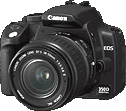
"There are always three things in a photograph, the photographer, the viewer and
CANON EOS 350D"
-- Harish Y S
Way back a few years ago there were no Digital SLRs and when they came they were not affordable. Like a bolt in the blue, Canon introduced its SLR camera in 2003. Then came the model EOS 300D which was the best in class then. Later came the EOS 350D, which is an improved version over EOS 300D but a totally newly developed camera. 350D has shrunk in size and appears more cuter than its predecessors.
This smallest Canon SLR has 8 megapixels to offer.... thanks to the new CMOS sensor it has got. Only olympus is the other camera that offers equal amount of pixels in this camera class. Nikon and Pentax have a Sony CMOS sensor which offer about 6 megapixels. Though this difference doesn't matter much, Canon has put a lot of effort in image rate and the processing (DIGIC II image processor) speed, which have increased tremendously. Naturally the Canon EOS 350D features the new E-TTL II flash system.
What I liked are :
- Excellent photo quality, even at high ISOs (assuming you watch the aperture on the kit lens or use another lens altogether)
- Great value for money : 8 Megapixel D-SLR
Full manual controls, no more "feature lockdown" like old Rebel - Robust performance and much faster
- Great low light focusing thanks to flash-based AF-assist
- Advanced white balance controls (though no ability to set WB by color temp.)
- RAW image format supported
- No redeye
- Very small and light weight for a D-SLR
- USB 2.0 High Speed interface
Overall I give Canon EOS 350D the thumbs up -- it's a great choice for those ready to move up to a digital SLR. Just be sure to buy a decent lens for it. I have a 18-55mm and 70-300mm lenses which are yet to be explored in a professional sense.
Why Digital Photography ?
Photography could be Fun, Hobby or a Profession... but it surely interests many different people across a broad range of ages. Technology also hasn't left it behind, with the advent and unbiquitous adoption of digital imaging technologies like digital cameras, scanners, photo printers and digital image editing softwares more and more enthusiasts have found a creative recreational hobby in photography.
There was a time when individuals interested in photography had to bear high investments. To get a serious start one had to purchase an SLR (Single Lens Reflection) camera, some dark room equipments and also the developing supplies.
With "Digital Photography" an individual has a much lower cost to pay to start with photography in a serious way. Compact cameras cost from US$50 and upwards, while a more creative and quality conscious "Digital SLR Cameras" are becoming more and more affordable starting anywhere from US$700 and upwards upto US$2000. A quality digital camera and an equally good image editing software is all needed to get started.
The real advantage is the "Flexibility" in digital photography. One can review, delete and print only those pictures which are needed - No more fuzzy out of focus prints.
There was a time when individuals interested in photography had to bear high investments. To get a serious start one had to purchase an SLR (Single Lens Reflection) camera, some dark room equipments and also the developing supplies.
With "Digital Photography" an individual has a much lower cost to pay to start with photography in a serious way. Compact cameras cost from US$50 and upwards, while a more creative and quality conscious "Digital SLR Cameras" are becoming more and more affordable starting anywhere from US$700 and upwards upto US$2000. A quality digital camera and an equally good image editing software is all needed to get started.
The real advantage is the "Flexibility" in digital photography. One can review, delete and print only those pictures which are needed - No more fuzzy out of focus prints.
Subscribe to:
Posts (Atom)